PRACTICAL SALES SOFTWARE GUIDE
CRM Demo Scorecard: Five Sales Workflows to Test Before You Buy
Put every CRM demo through the same five tests. Use fictional records, reconcile pipeline totals and record evidence, gaps and costs before choosing a supplier.
In this guide Show sections
- Prepare the same scenario for every supplier
- Test 1: capture and qualify a lead
- Test 2: move an opportunity and hand it over
- Test 3: control access and stop unwanted actions
- Test 4: produce a report you can reconcile
- Test 5: export and explain the exit path
- Use a simple scoring rule
- Copy this decision record
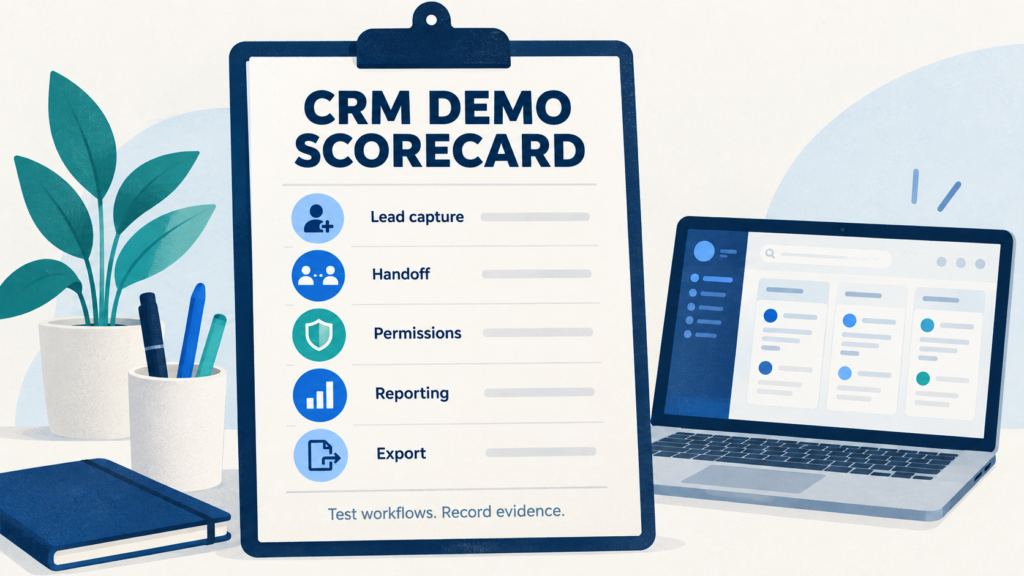
A polished CRM demonstration is not the same as proof that your team can use the software. A useful demo starts with your workflow, a small fictional dataset and a written definition of success. Give each shortlisted supplier the same tests, then record what happened rather than how impressive the presentation felt.
About this scorecard: This is an editorial evaluation method, not a ranking based on hands-on vendor testing. Adapt the tests to your organisation. Do not upload real customer data until your security and privacy requirements have been approved.
Prepare the same scenario for every supplier
Decide which ordinary user role will perform each test and keep outgoing messaging disabled. Use the same fictional dataset for every supplier so you can compare observed results rather than different demonstrations.
Send the scenario before the meeting. Ask the supplier to identify the exact plan, paid add-ons, seat types and configuration required. A demonstration on the most expensive edition does not validate a quote for a cheaper edition.
Create Example Company A, B and C, each with two fictional contacts. Use test addresses under your control and one test currency. Add the following opportunities, plus one unassigned lead, one overdue task and one contact suppressed from outreach.
| Record | Value | Stage | Owner | Next action |
|---|---|---|---|---|
| TEST-A | 1,000 | Qualified | Rep A | Discovery call |
| TEST-B | 2,000 | Proposal | Rep B | Proposal review |
| TEST-C | 3,000 | Qualified | Rep A | Confirm requirements |
The unweighted open-pipeline total is 6,000: Qualified contains 4,000 and Proposal contains 2,000. These are control totals, not a forecast or expected revenue.
Test 1: capture and qualify a lead
Ask a sales user to create a lead, record its source and assign an owner. Then introduce a duplicate and show how it is detected or handled. The goal is not a particular number of clicks: it is a complete record with an accountable next step.
- Pass evidence: the record retains the agreed required fields, source and owner.
- Follow-up: which rules need administrator configuration or another paid product?
- Failure to record: missing ownership, lost source data or an unresolved duplicate.
Test 2: move an opportunity and hand it over
Move a fictional opportunity to the next stage, set a next action and hand it to a colleague. Have that colleague explain what they can see without help from the presenter. Check whether history, attachments and tasks stay associated with the correct records.
Ask what happens when an owner leaves the organisation. A reassignment demonstration should include open work, not just a changed name on a contact.
Test 3: control access and stop unwanted actions
Run the workflow as a normal user as well as an administrator. Check that a user cannot view or export records outside the agreed access rules. Demonstrate the suppression or preference field used by your process, without sending a real message.
Record exactly what was tested. A successful demo is not a complete security audit or a legal compliance guarantee; unresolved requirements belong in a separate approval checklist.
Test 4: produce a report you can reconcile
Ask for open pipeline by stage and owner. The fictional records above should show 6,000 in total: 4,000 in Qualified and 2,000 in Proposal. Change TEST-A from 1,000 to 1,500. The total should become 6,500 and Qualified should become 4,500. These are unweighted control totals, not a forecast or expected revenue. Record when the source changed and when the report displayed it.
Ask the supplier to explain currency handling, excluded records and refresh timing where they matter. An attractive chart is not useful evidence if the team cannot explain why its total differs from the underlying records.
Test 5: export and explain the exit path
Export the fictional records through the documented interface. Check whether identifiers, relationships, notes and relevant fields are included. Ask which items require a separate export and what permissions or plan limits apply.
Record the answer as a demonstrated capability, a documented limitation or an unanswered question. Do not assume that an export of contacts also contains deal history, attachments and associations.
Use a simple scoring rule
- 2 — Demonstrated: your user completed the agreed test on the quoted plan, with evidence.
- 1 — Conditional: it works only with a stated workaround, extra cost or configuration that has not been validated.
- 0 — Not demonstrated: the test failed or was not shown.
Keep a separate must-have gate. A high total must not hide a failed mandatory requirement. Mark an unanswered question as unresolved, not as an assumed pass. The numbers organise a discussion; they are not a scientifically validated product ranking.
| Test | 0 / 1 / 2 | Evidence or gap | Owner / deadline |
|---|---|---|---|
| Capture | ____ | ________ | ________ |
| Handoff | ____ | ________ | ________ |
| Permissions | ____ | ________ | ________ |
| Reporting | ____ | ________ | ________ |
| Export | ____ | ________ | ________ |
Fictional example: a supplier scores 2 for capture, 2 for handoff, 0 for permissions, 2 for reporting and 1 for export. Its total is 7/10. That does not make it an acceptable choice if the permissions test was mandatory.
The next action is specific: ask the supplier to demonstrate the permission requirement on the quoted plan, with an owner and a deadline. Keep the decision on hold until that gap is resolved. If it cannot be met within the approved budget and operating model, remove the supplier from the shortlist.
For a conditional export score, record precisely what is missing. “Export needs follow-up” is weak. “The sample contains contacts but the association between TEST-A and Company A has not been verified” is actionable.
Copy this decision record
Supplier and plan: ____
Demo date and participants: ____
Required workflow: ____
Observed result and evidence: ____
Extra cost or workaround: ____
Open question, owner and deadline: ____
Decision: pass / conditional / not demonstrated.
Finish with a short trial in which your own users repeat the tasks. For budgeting, use our first-year CRM budget worksheet. For rollout preparation, use the implementation checklist. Some linked guides contain affiliate links; commercial relationships should not determine your test results.
Browse our CRM guides for related planning and comparison articles.