This article contains affiliate links. If you sign up for HubSpot through our links, we may earn a commission at no additional cost to you.
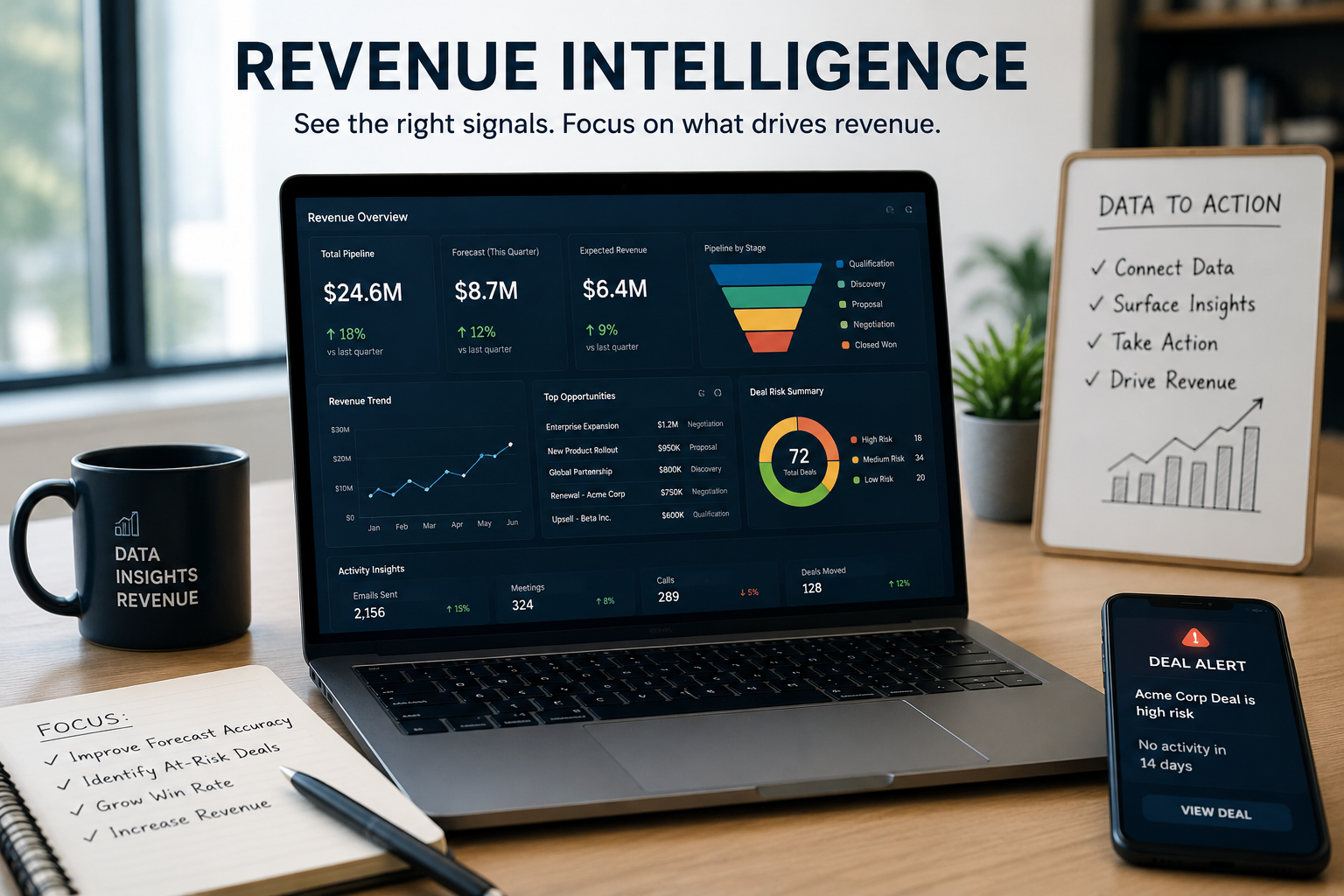
Revenue intelligence software helps sales teams understand what is happening inside their pipeline before the quarter ends. Platforms such as HubSpot Sales Hub, Clari, Gong, Salesforce, People.ai, and Aviso use CRM data, sales activity, conversations, forecasting, and AI to help teams identify deal risk and make better revenue decisions.
The right platform depends on where your revenue data already lives and what your team needs to improve. Some businesses primarily need better forecasting, while others need conversation intelligence, pipeline visibility, or a clearer connection between sales activity and revenue.
This guide compares the best revenue intelligence software in 2026 based on practical use cases, core capabilities, pricing, integrations, and the types of sales teams each platform suits best.
Quick Answer: What Is the Best Revenue Intelligence Software?
HubSpot Sales Hub is a strong choice for growing businesses that want revenue intelligence connected directly to CRM software, pipeline management, sales automation, and customer data. Clari is better suited to enterprise revenue forecasting, while Gong stands out for analyzing sales conversations and deal activity.
Salesforce is a logical option for organizations already running complex sales operations within its ecosystem. People.ai focuses heavily on sales activity and account intelligence, while Aviso provides AI-driven forecasting and revenue operations capabilities.
The best choice isn’t necessarily the platform with the most AI features. It is the one that turns the sales data your team already generates into information managers can actually use.
What Is Revenue Intelligence Software?
Revenue intelligence software collects and analyzes data from CRM records, sales activities, customer conversations, pipelines, and other revenue-related sources. It helps sales leaders understand which opportunities are progressing, which deals may be at risk, and whether the current pipeline is likely to produce the expected revenue.
Traditional sales reporting mainly explains what has already happened. Revenue intelligence goes further by looking for patterns and signals that can help teams decide what to do next.
For example, a sales manager might have $2 million in open pipeline but still struggle to determine how much of it is realistic. Revenue intelligence can provide additional context by examining deal movement, historical conversion patterns, sales activity, customer engagement, and other available signals.
That doesn’t make forecasting automatic or perfectly accurate. CRM data still needs to be complete and consistent. A practical HubSpot CRM dashboards and reporting workflow starts with clearly defined business goals and reliable CRM data before dashboards or AI-generated insights become useful.
What Should You Look for in Revenue Intelligence Software?
The most useful revenue intelligence platforms do more than produce another sales dashboard. They help managers understand why a forecast is changing and where action may be required.
For most sales organizations, the important capabilities include:
• Pipeline and deal visibility
• Revenue forecasting
• Deal-risk identification
• Sales activity analysis
• Conversation intelligence
• CRM integration
• AI-assisted insights
• Sales performance reporting
Not every business needs all of these capabilities. A company struggling primarily with forecast accuracy may value pipeline analytics more than call transcription, while a sales organization with dozens of customer conversations each day may gain more from conversation intelligence and coaching tools.
The underlying sales process matters just as much as the software. A structured sales tracking system should connect activities, opportunities, conversion rates, deal values, and pipeline movement so managers can identify problems before they affect revenue. How to Build an Effective Sales Tracking System That Drives Revenue Growth explains how those fundamentals support better forecasting and pipeline decisions.
Best Revenue Intelligence Software Compared
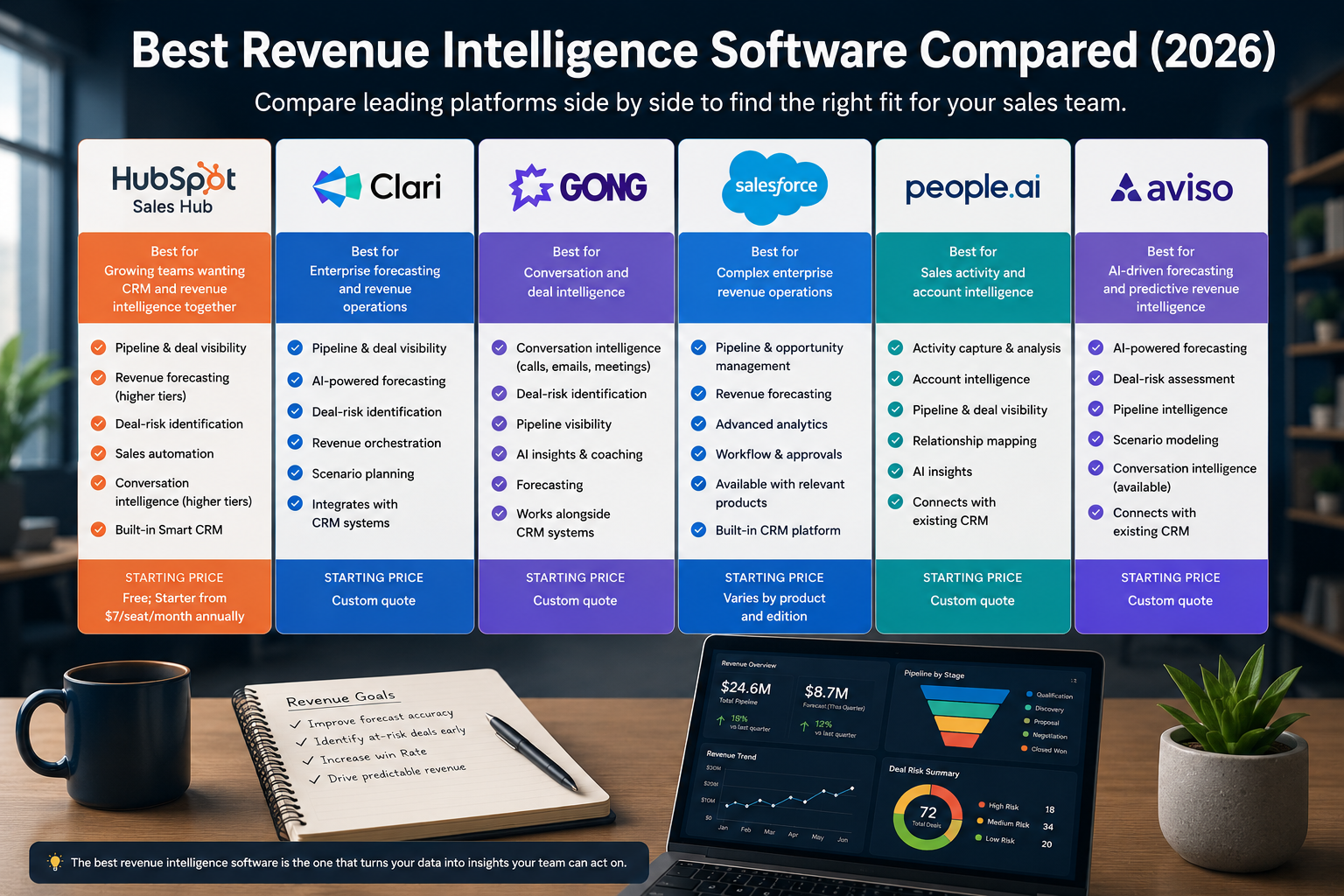
| Platform | Best For | Starting Price | Forecasting | Deal / Pipeline Intelligence | Conversation Intelligence | CRM Relationship |
|---|---|---|---|---|---|---|
| HubSpot Sales Hub | Growing teams wanting CRM and revenue intelligence together | Free; Starter from $7/seat/month annually | Available on higher tiers | ✓ | Available on higher tiers | Built-in Smart CRM |
| Clari | Enterprise forecasting and revenue operations | Custom quote | ✓ Core strength | ✓ | ✓ | Integrates with CRM systems |
| Gong | Conversation and deal intelligence | Custom quote | ✓ | ✓ | ✓ Core strength | Works alongside CRM systems |
| Salesforce | Complex enterprise revenue operations | Varies by product and edition | ✓ | ✓ | Available with relevant products | Built-in CRM platform |
| People.ai | Sales activity and account intelligence | Custom quote | Available by solution | ✓ | Capabilities vary | Connects with existing CRM |
| Aviso | AI-driven forecasting and predictive revenue intelligence | Custom quote | ✓ Core strength | ✓ | Available | Connects with existing CRM |
Pricing and packaging can change. Several dedicated revenue intelligence vendors use quote-based pricing, so businesses should confirm current costs and required integrations before purchasing.
The biggest distinction is whether revenue intelligence sits inside the CRM or on top of it. HubSpot and Salesforce can combine CRM records with revenue-related capabilities inside their broader platforms, while tools such as Clari and Gong are often used alongside an existing CRM to provide more specialized analysis.
1. HubSpot Sales Hub — Best for Connected CRM and Revenue Intelligence
HubSpot Sales Hub makes the most sense for businesses that want sales intelligence without separating it from the CRM where representatives already manage contacts, deals, meetings, and pipeline activity.
Rather than sending sales information into a separate intelligence platform, teams can work with data stored in HubSpot Smart CRM. Sales Hub adds capabilities for pipeline management, forecasting, sales analytics, conversation intelligence, prospecting, automation, and AI-assisted selling, although availability varies by subscription tier.
Consider a sales manager reviewing the quarter with several large opportunities still open. Pipeline data can show where each deal sits, forecasting tools can help estimate expected revenue, and conversation intelligence can provide additional context from recorded customer calls. The manager can then investigate an opportunity that appears healthy on paper but has stopped progressing.
This is where revenue intelligence becomes more useful than a standard dashboard. Instead of simply showing that a deal is open, the combination of CRM activity, pipeline history, customer interactions, and forecasting can help managers decide which opportunities need attention.
HubSpot describes Conversation Intelligence as a way to bring insights from customer calls into Smart CRM, giving sales teams more context for coaching and deal decisions.
HubSpot also reports measurable outcomes from Sales Hub customers: 73% of sales professionals say HubSpot increased their win rate, while customers close 94% more deals after six months. These are first-party results and individual outcomes will vary, but they provide useful context when evaluating the platform’s potential impact.
Best for: Growing sales organizations that want CRM, pipeline management, forecasting, sales automation, and revenue insights within a connected customer platform.
Drawback: Organizations that already have a deeply established CRM and only need highly specialized enterprise revenue forecasting may find a dedicated revenue intelligence platform more appropriate.
2. Clari — Best for Enterprise Revenue Forecasting
Clari is designed for organizations that need a detailed view of revenue across large and complex sales operations. Its main strength is bringing pipeline activity, forecasts, deal signals, and revenue workflows together so sales leaders can see where revenue may be at risk.
The platform is particularly useful when forecasts involve several teams, territories, or management levels. Rather than relying entirely on individual representatives to judge whether opportunities will close, managers can use pipeline activity and historical patterns to challenge assumptions and identify changes earlier.
For example, a regional sales leader may have several deals forecast to close before quarter-end. If opportunities remain in the same stage for too long or expected activity declines, Clari can help surface those signals so managers can investigate before accepting the forecast at face value.
This depth makes Clari particularly relevant to established revenue operations teams. Smaller organizations with straightforward pipelines may not need the additional layer of revenue management on top of their existing CRM.
Best for: Enterprise sales and revenue operations teams that need detailed forecasting and pipeline visibility.
Drawback: Clari may provide more functionality and complexity than smaller sales teams require, and pricing is generally provided through a custom quote.
3. Gong — Best for Conversation and Deal Intelligence
Gong approaches revenue intelligence from a different angle. While forecasting and pipeline analysis are part of its broader platform, Gong is particularly well known for turning sales conversations and customer interactions into usable revenue insights.
The platform can analyze calls, meetings, emails, and other interactions to help teams understand what is happening inside individual opportunities. This gives managers additional context that may not be obvious from CRM fields alone.
Imagine a deal that remains marked as likely to close even though the customer has stopped discussing implementation, pricing, or next steps during recent conversations. Conversation and engagement data can give managers another signal to consider when reviewing the opportunity.
This can also support sales coaching. Managers can review how representatives handle objections, discuss competitors, ask discovery questions, or progress conversations instead of relying entirely on self-reported deal notes.
Best for: Sales organizations that want conversation data to play a major role in deal analysis, coaching, and revenue decisions.
Drawback: Businesses mainly looking for basic CRM reporting and forecasting may not need a specialized conversation intelligence platform.
4. Salesforce — Best for Complex Enterprise Revenue Operations
Salesforce is a strong option for organizations that already manage extensive sales operations within its CRM ecosystem. Its revenue capabilities can draw on opportunity data, forecasting, analytics, automation, and AI across highly customized sales environments.
The main advantage is flexibility. Large organizations can structure reporting and forecasting around different territories, business units, products, sales hierarchies, and approval processes rather than forcing every team into the same revenue model.
For example, a multinational company may forecast enterprise sales separately from channel partnerships and renewals while still providing senior management with a broader view of expected revenue. Salesforce can support that level of customization when the CRM has been configured around the organization’s processes.
The trade-off is administration. More sophisticated CRM environments generally require stronger data governance, configuration, and ongoing management to keep reporting reliable.
Best for: Large organizations already using Salesforce and managing complex sales structures.
Drawback: The platform may require more configuration and administration than growing businesses with simpler revenue operations need.
5. People.ai — Best for Sales Activity and Account Intelligence
People.ai focuses on turning sales activity into structured information that revenue teams can use to understand account engagement and representative behavior.
This becomes especially useful in complex B2B sales, where one opportunity may involve several decision-makers. CRM records do not always capture every meeting, email, or interaction consistently, which can leave managers with an incomplete picture of how well an account is being developed.
Imagine a sales team pursuing a large enterprise account with six people involved in the buying decision. The opportunity may appear active because the representative regularly communicates with one contact, yet the team has built little engagement with finance, IT, procurement, or senior leadership. People.ai can help surface those relationship gaps by connecting sales activity with CRM and account data.
That visibility gives managers more context when reviewing important opportunities. Instead of simply asking whether an account is active, they can examine whether representatives are building relationships across the buying group or relying too heavily on a single contact.
Best for: Enterprise sales organizations that want deeper visibility into account engagement, sales activity, and relationships across complex buying groups.
Drawback: Smaller teams with straightforward sales cycles may find that their existing CRM already provides enough activity tracking for their needs.
6. Aviso — Best for AI-Driven Revenue Forecasting
Aviso focuses on using AI to support revenue forecasting, pipeline analysis, deal intelligence, and broader revenue operations.
The platform is designed to help sales leaders evaluate pipeline health using more than representative-submitted forecasts. Historical patterns, deal progression, engagement, and other revenue signals can provide additional context when estimating whether opportunities are likely to close.
Consider a $200,000 opportunity that a representative expects to close before the end of the month. The CRM stage may make the deal look healthy, but its recent activity, progression, and historical patterns from similar opportunities could indicate a higher level of risk. Predictive analysis gives the manager another perspective before including the full amount in the forecast.
This type of intelligence becomes particularly valuable when small forecasting errors can influence hiring, budgeting, inventory, or financial planning. The software doesn’t decide whether the deal will close; it gives revenue leaders additional evidence to consider when reviewing the forecast.
Best for: Revenue teams that place a high priority on AI-assisted forecasting and predictive pipeline analysis.
Drawback: Businesses with relatively simple sales cycles may not need the depth of predictive analysis offered by a specialized revenue intelligence platform.
How Does Revenue Intelligence Improve Sales Forecasting?
Revenue intelligence improves forecasting by adding context to the information already stored in the CRM. A deal may be marked as 80% likely to close, but that percentage alone says little about whether the customer is actively engaged or whether the opportunity has stopped progressing.
A stronger forecast combines pipeline stages with signals such as recent activity, deal movement, customer conversations, historical conversion rates, and representative behavior. Managers can then challenge forecasts based on evidence rather than relying entirely on intuition.
This becomes particularly valuable as the number of opportunities increases. Sales leaders cannot manually investigate every deal, so revenue intelligence helps direct attention toward the opportunities where something appears unusual.
This data-driven approach can also help sales teams focus their attention where it is most likely to have an impact. McKinsey’s research on data-driven B2B sales growth found that leading sales organizations use data and analytics to identify and prioritize opportunities, giving representatives clearer insight into where to focus their efforts.
Revenue intelligence should still support human judgment rather than replace it. A delayed deal may have a perfectly reasonable explanation that the software cannot understand, which is why managers and representatives still need to interpret the signals in context.
When Does a Business Actually Need Revenue Intelligence Software?
Not every sales team needs a dedicated revenue intelligence platform. A smaller organization with a short sales cycle and a manageable number of opportunities may get everything it needs from CRM reporting and basic forecasting.
The need becomes stronger when sales leaders struggle to trust forecasts, representatives manage large pipelines, opportunities involve many stakeholders, or management cannot easily identify which deals are genuinely progressing.
Revenue intelligence can also become useful when sales teams grow faster than management’s ability to review every opportunity manually. Instead of adding more layers of reporting, the goal is to identify the activities and signals most closely connected with revenue outcomes.
This is closely related to the challenge of improving lead qualification and sales efficiency. Better intelligence is most useful when it helps representatives and managers spend their time on opportunities with genuine potential rather than simply generating more data.
Revenue Intelligence Software vs CRM: What’s the Difference?
A CRM is primarily the system of record for customer and sales information. It stores contacts, companies, opportunities, activities, pipeline stages, and other data that sales teams use throughout the customer relationship.
Revenue intelligence analyzes that information and other sales signals to help teams understand what the data means. It can highlight deal risk, identify engagement patterns, improve forecasting, or surface opportunities that may require attention.
The distinction has become less clear as CRM platforms add AI, conversation intelligence, forecasting, and advanced analytics. HubSpot and Salesforce, for example, can now provide revenue-related intelligence within their broader CRM platforms, while specialized products such as Clari and Gong provide additional layers of analysis.
For businesses choosing between the two approaches, the key question is whether the existing CRM provides enough insight or whether the sales organization has become complex enough to justify a specialized revenue intelligence platform.
Which Revenue Intelligence Software Should You Choose?
The best platform depends on the problem your sales team is trying to solve.
HubSpot Sales Hub makes sense for growing businesses that want CRM, pipeline management, forecasting, automation, and sales intelligence in a connected environment. Clari is better suited to enterprises where forecasting and revenue orchestration are major operational priorities.
Gong stands out when customer conversations and sales coaching are central to the revenue strategy. Salesforce is particularly suitable for complex organizations already operating within its ecosystem, while People.ai focuses more heavily on activity and account intelligence. Aviso is worth considering when predictive forecasting is the primary requirement.
The decision should therefore start with the gap in your current sales process. If your CRM already provides sufficient forecasting and pipeline visibility, adding another platform may create unnecessary complexity. If managers consistently struggle to understand deal health or trust the forecast, specialized revenue intelligence can provide considerably more value.
Frequently Asked Questions
What does revenue intelligence software do?
Revenue intelligence software analyzes CRM data, pipeline activity, customer interactions, and other sales signals to help teams understand deal health, forecast revenue, and identify opportunities that may require attention.
Is revenue intelligence the same as sales intelligence?
No. Sales intelligence generally helps teams identify and research potential buyers, while revenue intelligence focuses more on existing pipeline activity, deal progression, forecasting, and revenue performance.
Is HubSpot Sales Hub a revenue intelligence platform?
Yes. HubSpot Sales Hub includes revenue intelligence capabilities such as AI-powered forecasting, sales analytics, pipeline management, and Conversation Intelligence within its CRM platform. This makes it particularly useful for teams that want revenue insights without adding a separate intelligence tool on top of their CRM.
Can a CRM provide revenue intelligence?
Yes. Modern CRM platforms increasingly include forecasting, analytics, AI, and conversation intelligence. Businesses with straightforward requirements may not need a separate revenue intelligence platform.
What is the best revenue intelligence software for small businesses?
Small businesses may benefit more from revenue intelligence built into an existing CRM rather than adding another specialized platform. HubSpot Sales Hub can be a practical option when CRM, pipeline management, forecasting, and sales analytics need to remain connected.
What is the best revenue intelligence platform for enterprises?
The answer depends on the organization’s existing technology and priorities. Clari is particularly focused on enterprise revenue operations, Gong emphasizes conversation intelligence, and Salesforce can support highly customized enterprise sales environments.
Does revenue intelligence replace sales managers?
No. Revenue intelligence helps managers identify patterns, risks, and opportunities more efficiently, but people still need to understand customer context, coach representatives, and make decisions that software cannot reliably make on its own.
How much does revenue intelligence software cost?
Revenue intelligence software ranges from CRM plans with built-in forecasting and analytics to enterprise platforms with custom pricing. Total cost can also depend on user count, CRM integrations, AI usage, implementation, and the level of forecasting or conversation intelligence required.
Final Thoughts
Revenue intelligence is most valuable when it turns scattered sales activity into information that helps teams make better decisions. The goal isn’t to collect more data; it’s to understand which opportunities are progressing, where revenue may be at risk, and what deserves attention.
Dedicated platforms such as Clari, Gong, People.ai, and Aviso provide deeper capabilities for organizations with specialized forecasting or intelligence requirements. Salesforce is particularly relevant to complex enterprises already operating within its ecosystem.
For growing teams that prefer to keep CRM records, pipeline management, forecasting, automation, and sales intelligence within the same environment, HubSpot Sales Hub offers a more integrated approach. Businesses can start with HubSpot’s CRM and evaluate whether its built-in sales capabilities are sufficient before deciding whether a separate revenue intelligence platform is necessary.