PRACTICAL SALES SOFTWARE GUIDE
Best Sales Enablement Software for Growing Teams (2026)
The best sales enablement software helps representatives find the right content, follow proven sales processes, prepare for customer conversations, and improve their skills as the team grows. HubSpot Sales Hub, […]
In this guide Show sections
- Quick Answer: What Is the Best Sales Enablement Software?
- What Is Sales Enablement Software?
- What Should Growing Teams Look for in Sales Enablement Software?
- Best Sales Enablement Software Compared
- 1. HubSpot Sales Hub — Best for CRM-Connected Sales Enablement
- 2. Highspot — Best for Enterprise Sales Content and Enablement
- 3. Seismic — Best for Content Personalization at Scale
- 4. Mindtickle — Best for Sales Readiness, Training, and Coaching
- 5. Showpad — Best for Sales Content and Buyer Engagement
- 6. Gong — Best for Conversation Intelligence and Sales Coaching
- Sales Enablement Software vs CRM: What’s the Difference?
- When Does a Growing Team Need Dedicated Sales Enablement Software?
- How Should You Choose Sales Enablement Software?
- Frequently Asked Questions
- What does sales enablement software do?
- What is the difference between sales enablement software and sales engagement software?
- Is HubSpot Sales Hub a sales enablement platform?
- What is the best sales enablement software for small or growing teams?
- What’s the difference between sales enablement and sales training?
- Do sales teams need both CRM and sales enablement software?
- How much does sales enablement software cost?
- Final Thoughts
This article contains affiliate links. If you sign up for HubSpot through our links, we may earn a commission at no additional cost to you.
The best sales enablement software helps representatives find the right content, follow proven sales processes, prepare for customer conversations, and improve their skills as the team grows. HubSpot Sales Hub, Highspot, Seismic, Mindtickle, Showpad, and Gong take different approaches to these challenges, ranging from CRM-connected playbooks to dedicated training, content management, and conversation intelligence.
For growing teams, the goal isn’t necessarily to build a complicated enablement program. It is to give representatives enough structure and guidance to sell consistently without forcing them to search through folders, documents, training portals, and disconnected sales tools every time they need help.
This guide compares the best sales enablement software in 2026 based on everyday usability, sales content, playbooks, coaching, analytics, integrations, pricing, and how well each platform can support a team as it expands.
Quick Answer: What Is the Best Sales Enablement Software?
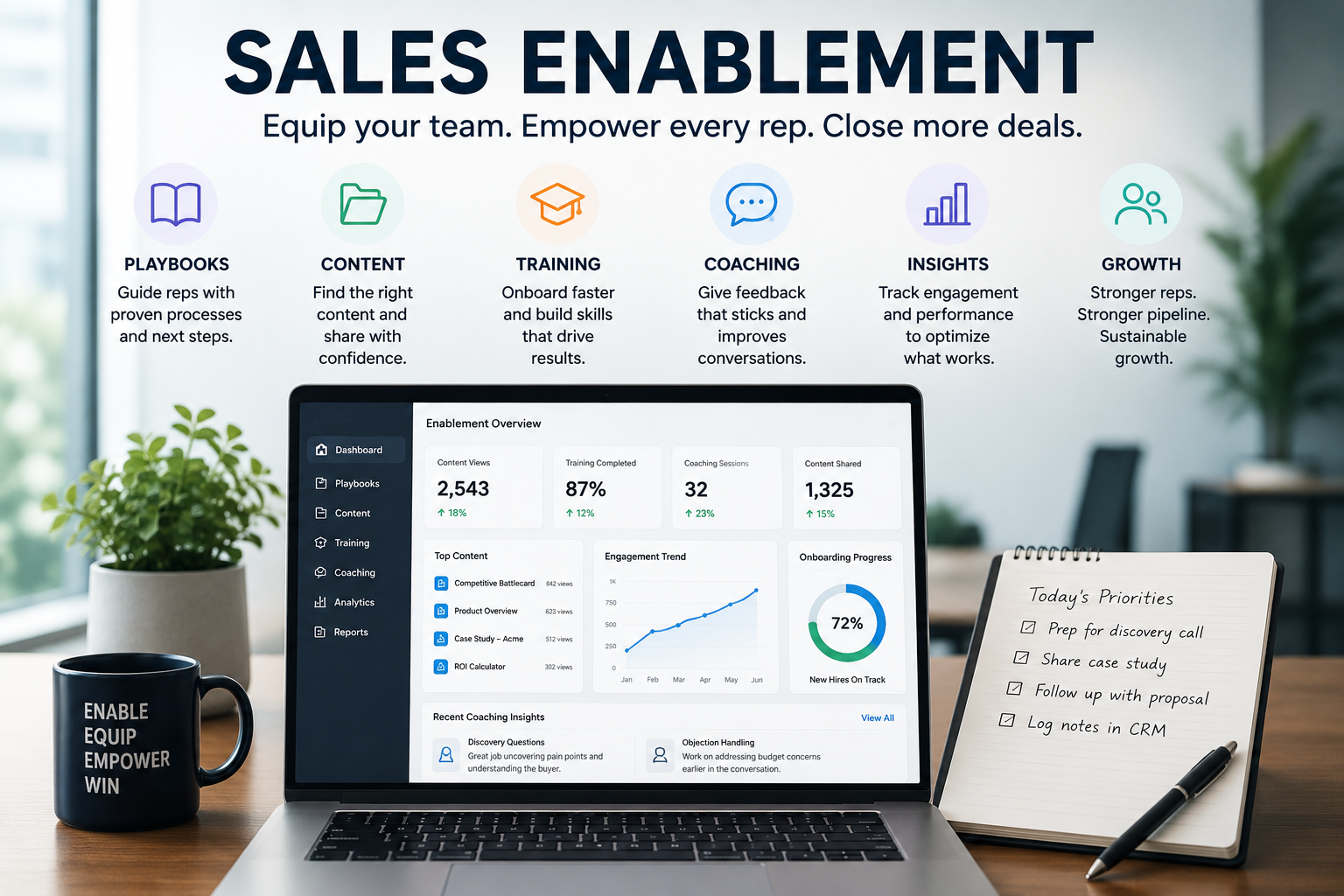
HubSpot Sales Hub is a strong choice for growing teams that want sales enablement connected directly to CRM software, prospect activity, pipelines, automation, and customer data. Representatives can access tools such as sales playbooks and guided selling within the same environment they use to manage opportunities.
Highspot and Seismic are better suited to organizations that need dedicated sales content management and enterprise enablement capabilities. Mindtickle stands out for sales readiness, training, and coaching, while Showpad combines content enablement with buyer engagement. Gong is particularly useful when conversation intelligence and coaching based on real customer interactions are priorities.
The right choice therefore depends on what your team needs help doing consistently: finding content, following the sales process, developing skills, or improving customer conversations.
What Is Sales Enablement Software?
Sales enablement software gives representatives the resources, guidance, training, and information they need to move opportunities forward more effectively.
That can include sales playbooks, product information, presentations, case studies, coaching, onboarding materials, conversation analysis, and recommended next steps. Some platforms concentrate heavily on managing sales content, while others focus on training or analyzing representative performance.
The difference becomes clearer when a team starts expanding.
Imagine a business grows from five sales representatives to 25. The original team may know which case study to send, how to handle a common pricing objection, or what questions to ask during discovery. New representatives don’t automatically have that knowledge.
Without a structured enablement system, they may develop their own processes, use outdated presentations, or repeatedly ask experienced colleagues for help. Sales enablement software turns more of that knowledge into a repeatable process.
That consistency also matters when outbound teams grow. Standardized playbooks and integrated technology can help representatives handle more opportunities without simply increasing headcount, which is one of the principles behind scaling outbound prospecting without adding more SDRs.
What Should Growing Teams Look for in Sales Enablement Software?
A growing business usually doesn’t need every enablement feature available. It needs software that solves the points where representatives are losing time or behaving inconsistently.
The most useful capabilities typically include:
• Sales playbooks and guided selling
• Content management and search
• Representative onboarding and training
• Sales coaching
• Conversation intelligence
• CRM integration
• Content engagement analytics
• Performance reporting
Ease of adoption matters just as much as the feature list. A sophisticated content library has limited value if representatives still keep their favorite presentations on their desktops because finding approved material takes too long.
The same applies to playbooks. They should help representatives during actual selling rather than become another internal document nobody opens. If a prospect raises a pricing objection, for example, a useful enablement system should make the relevant questions, guidance, or approved content easy to find while the opportunity is active.
This is closely connected to pipeline consistency. A structured sales process helps teams define how opportunities should progress and what needs to happen at each stage, while pipeline management tools give managers greater visibility into whether representatives are actually following that process.
Best Sales Enablement Software Compared
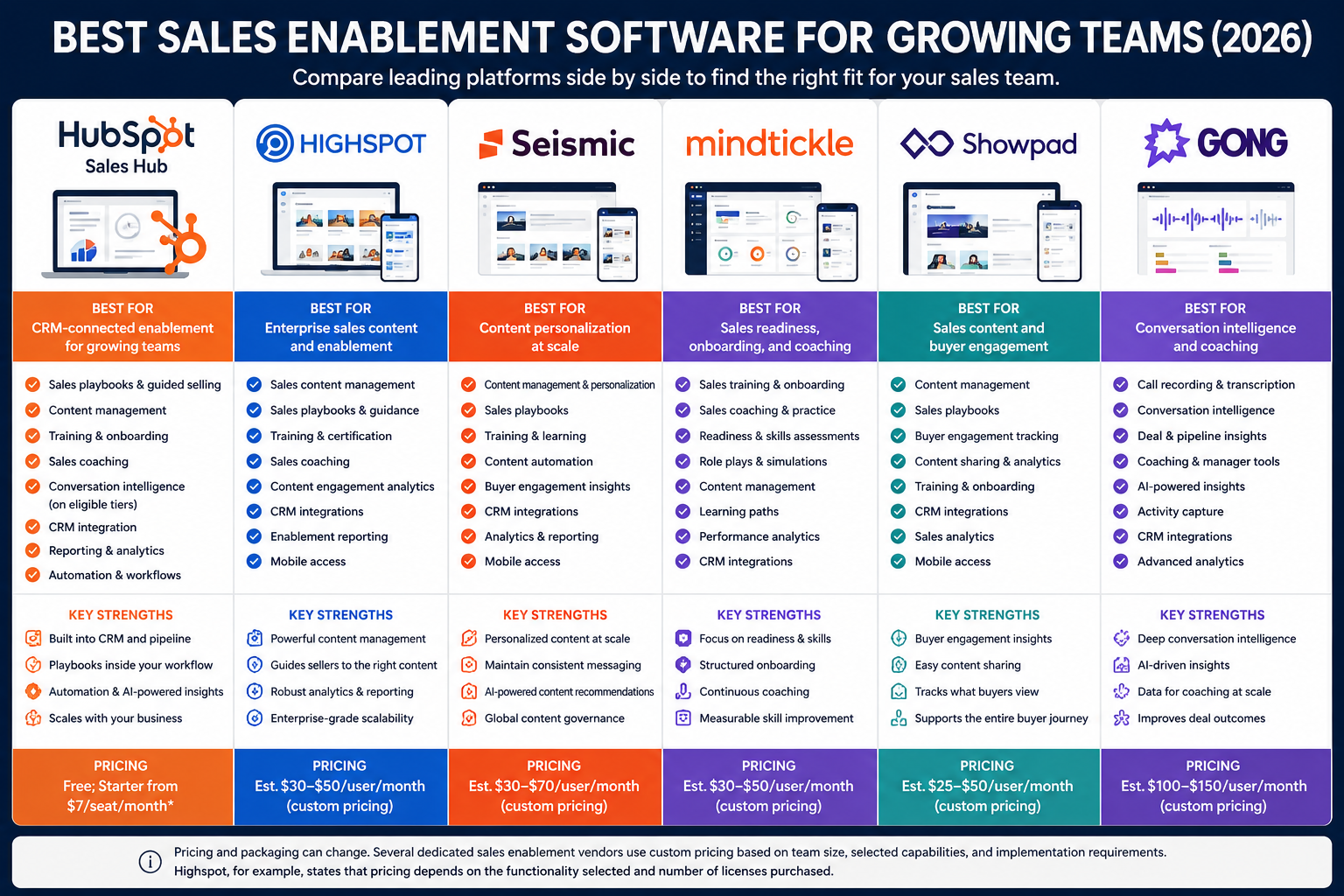
| Platform | Best For | Approx. Starting Price | Playbooks / Guidance | Content Enablement | Training / Coaching | Conversation Intelligence |
|---|---|---|---|---|---|---|
| HubSpot Sales Hub | CRM-connected enablement for growing teams | Free; Starter from $7/seat/month* | ✓ | ✓ | Available by tier | ✓ on eligible tiers |
| Highspot | Enterprise sales content and enablement | Est. $30–$50/user/month | ✓ | ✓ Core strength | ✓ | Available |
| Seismic | Content personalization at scale | Est. $50–$70/user/month | ✓ | ✓ Core strength | ✓ | Available |
| Mindtickle | Sales readiness, onboarding, and coaching | Est. $30–$50/user/month | ✓ | ✓ | ✓ Core strength | Available |
| Showpad | Sales content and buyer engagement | Est. $25–$50/user/month | ✓ | ✓ Core strength | ✓ | Available |
| Gong | Conversation intelligence and coaching | Est. $100–$150/user/month | Deal/conversation guidance | Limited | ✓ | ✓ Core strength |
Pricing and packaging can change. Several dedicated sales enablement vendors use custom pricing based on team size, selected capabilities, and implementation requirements. Highspot, for example, states that pricing depends on the functionality selected and number of licenses purchased.
The table also shows why sales enablement isn’t one software category with six interchangeable products. Highspot and Seismic emphasize managing and delivering sales content, Mindtickle focuses more heavily on readiness and coaching, and Gong approaches enablement through actual customer conversations.
HubSpot takes another route by placing enablement tools closer to CRM records and the active sales process. That can be useful for growing teams that don’t want representatives moving between a CRM and a separate enablement platform throughout the day.
1. HubSpot Sales Hub — Best for CRM-Connected Sales Enablement
HubSpot Sales Hub is best suited to growing teams that want sales enablement to happen inside the same environment where representatives manage prospects and opportunities.
The distinction is important because sales enablement often fails when useful information exists but isn’t available when a representative actually needs it.
Consider a new representative preparing for a discovery call with an active opportunity. Instead of opening the CRM, searching a shared drive for a discovery checklist, looking elsewhere for previous conversations, and then asking a manager which questions to use, the representative can work from the customer record and use relevant sales guidance within the same broader workflow.
HubSpot’s playbook capabilities are particularly relevant here. Teams can create standardized guidance for activities such as discovery calls, qualification, competitive conversations, or customer handoffs. This helps managers turn successful sales practices into processes that newer representatives can follow more consistently.
That becomes increasingly useful as the team expands. Managers don’t need to personally explain the same process every time someone joins, while representatives still have access to customer context rather than following a generic script without understanding the opportunity.
The CRM connection also gives managers another perspective on enablement. Training and guidance should ultimately improve what happens inside the pipeline. HubSpot reporting can connect sales activity and deal information with broader performance data, making it easier to see whether processes are actually being followed rather than judging enablement purely by training completion. A more detailed HubSpot CRM reporting workflow shows how centralized sales data can help teams connect day-to-day activity with business outcomes.
HubSpot also combines these capabilities with prospecting, automation, AI-assisted selling, and conversation intelligence on eligible Sales Hub tiers. The advantage isn’t that every representative needs every feature. It’s that enablement can remain connected to the customer and deal data already guiding the sales process.
Best for: Growing teams that want CRM, playbooks, sales guidance, automation, pipeline data, and enablement capabilities in a connected environment.
Drawback: Organizations that need a large, highly specialized sales-content library, extensive learning programs, or enterprise-wide enablement management may prefer a dedicated platform such as Highspot, Seismic, or Mindtickle.
2. Highspot — Best for Enterprise Sales Content and Enablement
Highspot is a dedicated sales enablement platform designed to help organizations organize sales content, guide representatives through proven selling behaviors, and measure whether enablement efforts are improving performance.
Its content management capabilities are particularly useful for businesses with large libraries of presentations, case studies, product information, competitive materials, and other sales resources. Instead of expecting representatives to remember where everything is stored, teams can organize approved content and make relevant resources easier to find during the sales process.
Consider a representative preparing a proposal for a prospect in the financial services industry. The company may have dozens of case studies and presentations, but only a few are relevant to that particular buyer. Highspot can help surface appropriate material rather than leaving the representative to search through folders or reuse whatever presentation happens to be familiar.
This also gives marketing and enablement teams more control over content. They can update resources centrally and gain insight into which materials representatives actually use and how buyers engage with them.
Highspot becomes especially valuable when enablement extends across large sales organizations where keeping content, training, and sales guidance consistent becomes difficult to manage manually.
Best for: Larger sales organizations that need dedicated content management, sales guidance, training, and enablement analytics.
Drawback: Growing teams with relatively small content libraries may not need the depth of a dedicated enterprise enablement platform.
3. Seismic — Best for Content Personalization at Scale
Seismic is particularly useful for organizations that need to manage large amounts of sales content while adapting that material for different buyers, industries, products, or markets.
This becomes increasingly difficult as a sales organization grows. Marketing may create approved presentations, case studies, product information, and messaging, but representatives still need to make those materials relevant to individual opportunities without creating their own versions from scratch.
Imagine a global software company selling to healthcare, financial services, and manufacturing businesses. The core presentation may remain the same, but customer examples, product information, messaging, and supporting materials need to change depending on the prospect. Seismic helps teams work from centrally managed content while giving representatives a more efficient way to deliver relevant materials.
This makes Seismic different from simply having a searchable content library. Its value becomes stronger when businesses need to maintain consistent, governed content while personalizing what buyers receive at scale.
Best for: Larger sales organizations that need sophisticated content management and personalization across multiple markets, products, or buyer segments.
Drawback: Smaller teams with relatively simple content requirements may not need the level of content management and personalization Seismic is designed to support.
4. Mindtickle — Best for Sales Readiness, Training, and Coaching
Mindtickle approaches sales enablement with a stronger emphasis on whether representatives are actually prepared to sell.
That includes onboarding, training, coaching, skills development, practice, and measuring sales readiness. This makes it particularly useful when a growing organization needs to bring new representatives up to speed consistently rather than relying on informal shadowing and occasional training sessions.
Imagine a company hiring 15 new sales representatives across several locations. Managers need everyone to understand the product, qualification process, competitive positioning, common objections, and messaging before they begin handling important opportunities.
A sales readiness platform can create a more structured process for developing those skills and identifying where additional coaching may be required.
The value continues after onboarding. Products change, competitors introduce new offers, and sales messaging evolves. Ongoing readiness programs can help established representatives keep their knowledge current rather than treating enablement as something that happens only during their first few weeks.
Best for: Organizations where onboarding, representative readiness, continuous training, and coaching are the main enablement priorities.
Drawback: Teams primarily looking for CRM-connected playbooks or a central sales-content library may find other platforms better aligned with their needs.
5. Showpad — Best for Sales Content and Buyer Engagement
Showpad combines sales content management with buyer engagement capabilities, making it particularly useful for teams that want to understand what happens after sales material is shared with a prospect.
Representatives can organize and deliver relevant presentations, case studies, product information, and other resources throughout the buying process. The additional value comes from gaining more visibility into how buyers interact with that material.
For example, a representative might send a case study after a discovery call. Rather than treating the document as something that disappears once it is sent, engagement information can provide another signal about whether the prospect is interacting with the material and what may be attracting their attention.
That information doesn’t prove that a deal will close, but it can give representatives additional context when deciding how and when to follow up. It can also help enablement and marketing teams understand which sales materials are actually being used and engaging buyers.
Best for: Sales teams that want centralized sales content combined with greater visibility into buyer engagement.
Drawback: Organizations primarily focused on intensive sales training, readiness, or conversation coaching may find a more specialized platform better suited to those priorities.
6. Gong — Best for Conversation Intelligence and Sales Coaching
Gong takes a different approach to sales enablement because much of its value comes from analyzing what happens during actual customer interactions.
Rather than relying only on training materials or playbooks, conversation intelligence can help managers understand how representatives conduct discovery, respond to objections, discuss competitors, and move conversations toward clear next steps.
Consider a manager responsible for 12 representatives. Listening manually to every sales call would be unrealistic. Conversation intelligence can make it easier to identify calls or moments worth reviewing, giving the manager a more practical way to coach at scale.
The same information can reveal patterns across the wider team. If prospects repeatedly raise the same objection or representatives consistently struggle with a particular stage of discovery, enablement leaders have clearer evidence of where coaching or new content may be needed.
Gong therefore works particularly well when organizations view real customer conversations as a source of enablement data, rather than relying mainly on formal training and content libraries.
Best for: Sales organizations that want conversation intelligence, call analysis, and coaching based on real customer interactions.
Drawback: Gong isn’t primarily a traditional sales-content management platform, so organizations needing extensive content organization and distribution may still require additional enablement capabilities.
Sales Enablement Software vs CRM: What’s the Difference?
A CRM and sales enablement platform solve related but different problems.
CRM software records the customer relationship. It typically stores contacts, companies, deals, activities, pipeline stages, and other information representatives need to manage opportunities.
Sales enablement software helps representatives use information, content, guidance, and training more effectively during that relationship.
The distinction is becoming less clear as CRM platforms add enablement capabilities. HubSpot, for example, combines CRM records with playbooks, conversation intelligence, sales content, automation, and other Sales Hub tools. Dedicated platforms such as Highspot, Seismic, and Mindtickle provide deeper functionality in particular areas of enablement.
This means a growing team shouldn’t automatically assume it needs another platform. The first question should be whether the enablement capabilities available within its existing sales system can solve the actual problem.
When Does a Growing Team Need Dedicated Sales Enablement Software?
A five-person sales team may be able to share knowledge informally. Representatives can ask a manager which presentation to use or how to respond to an unusual objection.
That becomes harder with 20, 50, or several hundred representatives.
Dedicated sales enablement becomes more valuable when new representatives take too long to become productive, sales content becomes difficult to manage, teams use inconsistent messaging, managers cannot coach everyone effectively, or representatives repeatedly struggle to find the right information during active opportunities.
The need can also appear when sales and marketing become disconnected. Marketing may continue producing presentations, case studies, and other resources without knowing whether representatives actually use them.
The objective isn’t to create more internal material. It’s to make the knowledge the business already has easier to find and apply during real sales situations.
How Should You Choose Sales Enablement Software?
Start with the specific problem you’re trying to fix.
If representatives struggle to find approved content, Highspot, Seismic, or Showpad may deserve closer consideration. If onboarding and readiness are the biggest issues, Mindtickle provides a more specialized approach.
If managers need better visibility into real customer conversations, Gong is particularly relevant. If the priority is keeping playbooks, customer information, pipeline activity, automation, and sales guidance connected, HubSpot Sales Hub may provide enough enablement capability without introducing another standalone system.
Also consider how the platform fits into the existing technology stack. Adding specialized software can be worthwhile when it solves a genuine gap, but every additional platform introduces another integration, data source, subscription, and system representatives need to learn.
The best sales enablement software is therefore not necessarily the product with the longest feature list. It’s the one that removes the specific barriers preventing representatives from selling consistently.
Frequently Asked Questions
What does sales enablement software do?
Sales enablement software gives representatives access to content, guidance, training, coaching, and insights that help them handle sales conversations and opportunities more consistently.
What is the difference between sales enablement software and sales engagement software?
Sales enablement software helps representatives access content, training, coaching, and guidance. Sales engagement software focuses more on executing prospect interactions through channels such as email, calls, and automated outreach sequences. Some platforms include elements of both.
Is HubSpot Sales Hub a sales enablement platform?
Yes. HubSpot Sales Hub includes sales enablement capabilities such as playbooks, sales content, conversation intelligence, coaching-related tools, automation, and CRM-connected sales guidance, with availability depending on the subscription tier. It can be particularly useful for growing teams that want enablement connected to their existing customer and pipeline data.
What is the best sales enablement software for small or growing teams?
Growing teams should prioritize ease of adoption and integration with their existing sales process. HubSpot can suit teams wanting enablement inside their CRM environment, while dedicated platforms may make more sense as content, training, or coaching requirements become more specialized.
What’s the difference between sales enablement and sales training?
Sales training focuses primarily on developing representative knowledge and skills. Sales enablement is broader and can include training, content, playbooks, coaching, technology, customer insights, and processes that help representatives sell effectively.
Do sales teams need both CRM and sales enablement software?
Not always. Some CRM platforms already provide sales enablement capabilities. A separate platform becomes more valuable when a business needs specialized content management, readiness, coaching, or analytics beyond what its CRM provides.
How much does sales enablement software cost?
Pricing varies considerably. Some CRM-connected enablement capabilities are included within paid sales software plans, while dedicated enterprise platforms such as Highspot, Seismic, Mindtickle, Showpad, and Gong commonly use custom pricing based on users, functionality, and implementation requirements.
Final Thoughts
Sales enablement software becomes valuable when growth makes it difficult to rely on informal knowledge sharing. The right platform should help representatives find useful information, follow consistent processes, develop their skills, and apply what they learn during real customer conversations.
Highspot, Seismic, and Showpad are particularly relevant when sales content is the main challenge. Mindtickle provides a stronger focus on readiness and training, while Gong uses customer conversations to support coaching and performance improvement.
For growing teams that want enablement connected directly to customer records and active opportunities, HubSpot Sales Hub offers a more integrated approach. Teams can use their existing CRM workflow as the foundation and determine whether they need a more specialized enablement platform as their sales organization becomes more complex.