PRACTICAL SALES SOFTWARE GUIDE
HubSpot vs Salesforce Marketing Cloud: Which Marketing Platform Is Right for Your Business?
HubSpot Marketing Hub and Salesforce Marketing Cloud are both powerful marketing platforms, but they are designed around different levels of marketing complexity. HubSpot is generally better suited to growing teams […]
In this guide Show sections
- Quick Answer: HubSpot vs Salesforce Marketing Cloud
- HubSpot vs Salesforce Marketing Cloud at a Glance
- What Is HubSpot Marketing Hub Best For?
- What Is Salesforce Marketing Cloud Best For?
- How Do HubSpot and Salesforce Marketing Cloud Approach Automation Differently?
- When Does a Business Actually Need an Enterprise Marketing Platform?
- How Do HubSpot and Salesforce Marketing Cloud Use AI?
- Which Platform Is Better for Segmentation and Personalization?
- Which Platform Is Better for Customer Journey Management?
- HubSpot vs Salesforce Marketing Cloud for Analytics and Attribution
- Which Platform Is Easier to Use?
- HubSpot vs Salesforce Marketing Cloud Pricing
- Which Platform Should Your Business Choose?
- Frequently Asked Questions
- Is HubSpot Marketing Hub better than Salesforce Marketing Cloud?
- Is HubSpot Marketing Hub suitable for large businesses?
- Can HubSpot replace Salesforce Marketing Cloud?
- Does HubSpot Marketing Hub include CRM software?
- How much do HubSpot Marketing Hub and Salesforce Marketing Cloud cost?
- Does Salesforce Marketing Cloud include AI?
- Which platform is better for small businesses?
- Final Thoughts
This article contains affiliate links. If you sign up for HubSpot through our links, we may earn a commission at no additional cost to you.
HubSpot Marketing Hub and Salesforce Marketing Cloud are both powerful marketing platforms, but they are designed around different levels of marketing complexity. HubSpot is generally better suited to growing teams that want CRM, marketing automation, content, lead generation, AI, and reporting in one connected platform. Salesforce Marketing Cloud is stronger for larger organizations that need advanced journey orchestration, segmentation, personalization, and enterprise-scale campaign management.
The difference becomes more important as marketing operations grow. A platform that works well for a smaller team may become difficult to manage once a business adds more channels, regions, customer segments, approval processes, and data sources.
This guide compares HubSpot and Salesforce Marketing Cloud across automation, customer journeys, segmentation, AI, analytics, ease of use, pricing, and scalability so you can determine which platform better matches the way your marketing team actually works.
Quick Answer: HubSpot vs Salesforce Marketing Cloud
Choose HubSpot Marketing Hub if you want marketing automation closely connected with CRM software, lead management, content, reporting, and customer data without building a heavily customized marketing stack.
Choose Salesforce Marketing Cloud if your organization needs sophisticated customer journeys, complex audience segmentation, advanced personalization, and large-scale campaign orchestration across multiple teams, markets, or brands.
Neither platform is automatically better for every business. The right choice depends largely on the complexity of your marketing operation and how much technical configuration your team is prepared to manage.
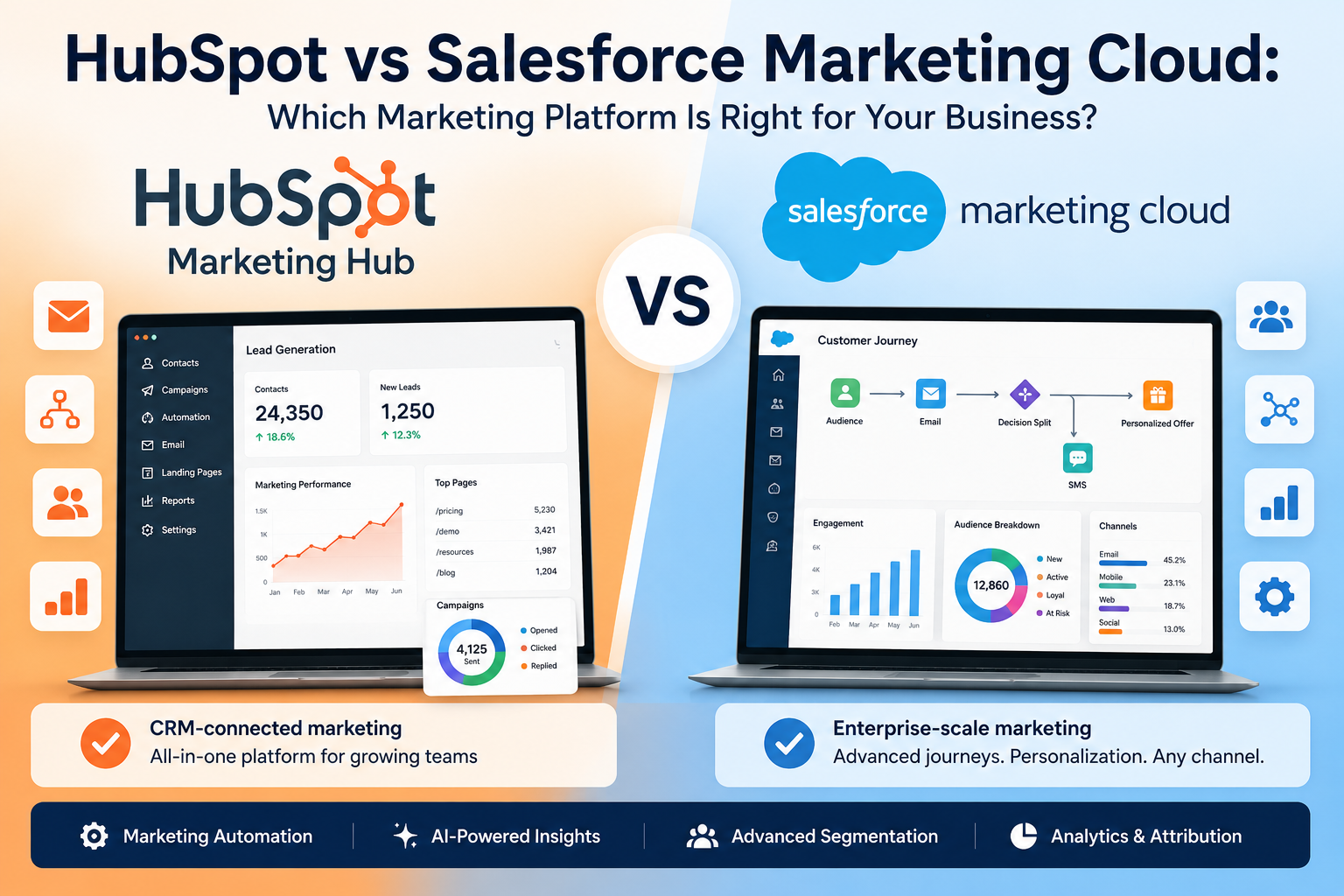
HubSpot vs Salesforce Marketing Cloud at a Glance
| Category | HubSpot Marketing Hub | Salesforce Marketing Cloud |
|---|---|---|
| Best for | Growing teams wanting CRM-connected marketing | Enterprises needing advanced journey orchestration and personalization |
| Starting price | Free tools; Starter from $7/seat/month annually*; Professional from $800/month annually | Marketing Cloud Growth from $1,500/org/month |
| Marketing automation | ✓ | ✓ |
| CRM connection | Native with HubSpot Smart CRM | Native within Salesforce ecosystem |
| Email marketing | ✓ | ✓ |
| Customer journeys | Strong workflows and lifecycle automation | ✓ Core strength |
| Segmentation | ✓ | ✓ Advanced |
| AI marketing tools | HubSpot AI tools, including Breeze Assistant and AI agents | Agentforce and Einstein capabilities |
| Content tools | Native HubSpot content ecosystem | Available across Salesforce products and integrations |
| Analytics and attribution | Marketing + CRM reporting | Advanced enterprise analytics |
| Ease of adoption | Generally easier for growing teams | Better suited to organizations prepared for greater configuration |
| Best fit as you scale | Teams wanting marketing, CRM, sales, and service connected | Complex operations across brands, regions, channels, and data sources |
*HubSpot’s $7 Starter price is promotional annual-billing pricing and can change. Pricing and feature availability vary by edition, contacts, usage, implementation requirements, and additional products.
The biggest difference isn’t simply the number of features. HubSpot focuses on keeping marketing closely connected to CRM and the wider customer journey, while Salesforce Marketing Cloud is built to handle more complex enterprise campaign orchestration and personalization.
What Is HubSpot Marketing Hub Best For?
HubSpot Marketing Hub is best for teams that want lead generation, marketing automation, content, CRM data, and campaign reporting to work together without relying on several disconnected platforms.
A growing marketing team may begin with email campaigns and landing pages, then gradually add lead nurturing, segmentation, paid campaigns, content, and more advanced reporting. HubSpot allows those activities to remain connected to HubSpot Smart CRM, giving marketers visibility into what happens after a contact clicks, converts, speaks with sales, or eventually becomes a customer.
Consider a professional services firm generating leads through webinars and downloadable guides. A prospect submits a form, enters an automated nurturing workflow, receives relevant follow-up content, and eventually books a consultation. Because those interactions remain connected to the CRM, the marketing team can see which campaigns influenced opportunities instead of measuring performance only through email opens or website traffic.
That connection becomes increasingly useful as marketing and sales begin sharing responsibility for revenue. Teams can create more consistent handoffs between lead generation, qualification, sales follow-up, and customer communication.
Choosing the right marketing automation platform becomes particularly important as those workflows become more complicated. Automation is most useful when it supports a clear customer journey rather than simply increasing the number of messages being sent.
HubSpot also brings AI-assisted marketing into this connected environment through its AI tools, including Breeze Assistant and AI agents, alongside campaign management, segmentation, reporting, and content capabilities. A marketer can use AI to help develop campaign content, work with customer data to identify relevant audiences, and support follow-up without separating those activities from the underlying CRM.
HubSpot’s current Marketing Hub information provides more detail on its marketing automation, AI, lead generation, personalization, and reporting capabilities. HubSpot Marketing Hub features
Best for: Growing businesses that want CRM-connected marketing automation, lead generation, content, AI, and reporting in one environment.
Drawback: Organizations with highly complex global marketing operations, extensive data models, or advanced cross-brand journey orchestration may benefit from the deeper enterprise configuration available in Salesforce Marketing Cloud.
What Is Salesforce Marketing Cloud Best For?
Salesforce Marketing Cloud is best suited to larger organizations that need sophisticated customer journeys, advanced segmentation, enterprise personalization, and campaign management across multiple channels, regions, or brands.
Its strengths become more obvious when a business has a complicated marketing structure. A global retailer, for example, may need different campaigns for loyalty members, new customers, dormant buyers, high-value customers, and several geographic markets while coordinating interactions across email, mobile, advertising, and other touchpoints.
Salesforce Marketing Cloud is designed for this type of environment. Rather than treating every customer as part of a relatively simple campaign funnel, organizations can work with larger datasets and create different experiences based on behavior, attributes, lifecycle stage, and other customer signals.
Imagine a multinational ecommerce company with customers across several markets. A first-time buyer in one region may enter a different journey from a long-term customer in another region who has stopped purchasing. Messaging could also vary according to product interests, loyalty status, previous interactions, and other available customer data.
That level of flexibility can be valuable, but it comes with a trade-off. More sophisticated enterprise marketing environments typically require stronger data governance, greater configuration, and more technical resources to manage effectively.
For smaller teams, that level of complexity may offer little practical advantage. For organizations coordinating large datasets, multiple business units, and highly personalized customer experiences, it can be precisely what makes Salesforce Marketing Cloud valuable.
How Do HubSpot and Salesforce Marketing Cloud Approach Automation Differently?
Both platforms support marketing automation, but they approach it from different starting points.
HubSpot emphasizes CRM-connected workflows. Marketers can use contact properties, lifecycle stages, form submissions, campaign activity, and other customer information to trigger actions and nurture leads through the buying process.
For example, someone who downloads a pricing guide could enter an educational workflow, while a prospect who requests a demo could be routed toward sales much more quickly. Because the activity remains connected to CRM data, marketing can then evaluate whether those different paths contribute to opportunities and revenue.
This is particularly useful when sales and marketing share responsibility for the same customer journey. A practical HubSpot CRM reporting setup can help teams connect campaign activity with pipeline movement and business outcomes rather than measuring marketing in isolation.
Salesforce Marketing Cloud emphasizes more complex journey orchestration. Large organizations can coordinate customer experiences across multiple segments, touchpoints, datasets, and business units, making the platform better suited to situations where the journey varies considerably according to region, product, audience, or customer behavior.
This creates a fairly straightforward distinction. HubSpot is often easier to manage when the priority is CRM-connected automation for a growing business. Salesforce Marketing Cloud becomes more compelling when automation needs to coordinate sophisticated enterprise segmentation and cross-channel customer journeys.
When Does a Business Actually Need an Enterprise Marketing Platform?
A business does not need enterprise marketing software simply because its contact database is growing.
The need becomes stronger when campaigns span several regions or brands, customer segmentation becomes highly complex, multiple teams require different permissions and workflows, or marketers need to coordinate experiences using data from many different sources.
Another warning sign is when campaign management starts depending heavily on manual exports, disconnected audience lists, and repeated data cleanup. At that point, the challenge is no longer simply creating campaigns. It is managing the customer data and orchestration behind them.
Growing teams should still avoid buying complexity they don’t need. A simpler platform that supports the current marketing operation and can expand with the business may provide more value than an enterprise system whose advanced capabilities remain largely unused.
How Do HubSpot and Salesforce Marketing Cloud Use AI?
AI plays an increasingly important role in both platforms, but the value comes from how it fits into the marketing workflow rather than how many AI features are available.
HubSpot integrates its AI tools across its customer platform, allowing AI-assisted marketing to work alongside CRM data, campaigns, content, and automation.
Imagine a marketing team preparing a nurture campaign for prospects who recently downloaded a guide. Breeze Assistant can help develop and refine campaign content, while other HubSpot AI tools can support marketing workflows using CRM context. The team can then follow how those contacts progress instead of treating AI-generated content as a separate part of the marketing process.
This CRM connection is one of the more practical advantages of HubSpot’s approach. AI becomes part of an existing marketing workflow rather than another standalone tool marketers need to manage. Some of these applications are covered more closely in 10 Best HubSpot AI Features Changing Marketing Campaigns.
Salesforce takes a more enterprise-oriented approach through Agentforce and Einstein, particularly within Marketing Cloud Next. AI can support activities such as campaign creation, audience development, personalization, optimization, and journey-related decisions.
This becomes particularly useful when AI needs to work across large amounts of customer data. A global organization, for example, might use customer behavior, purchase information, preferences, and engagement signals to determine how different audiences should be treated across campaigns.
Verdict: HubSpot has the advantage for teams that want AI integrated into an accessible CRM and marketing workflow. Salesforce Marketing Cloud is better suited to organizations applying AI across more complex enterprise data and customer journeys.
Which Platform Is Better for Segmentation and Personalization?
Both platforms can segment audiences and personalize marketing, but the level of complexity they are designed to handle differs.
HubSpot allows marketers to build audiences using CRM properties, lifecycle information, behaviors, engagement, and other customer data.
Consider a B2B company with 20,000 contacts. Marketing could separate prospects by industry, lifecycle stage, previous content engagement, or product interest and use those segments to create more relevant campaigns. Because the segmentation uses information already connected to the CRM, teams don’t necessarily need to maintain separate customer databases for routine targeting.
For many growing businesses, that provides enough flexibility for lead nurturing, customer marketing, re-engagement, and other lifecycle campaigns.
Salesforce Marketing Cloud becomes more compelling when segmentation depends on much larger or more complicated datasets. Marketing Cloud Next can work with Data 360 to unify customer information from multiple sources and make that information available for segmentation and personalization.
Imagine a global retailer targeting customers who purchased within the last six months, belong to a particular loyalty tier, live in selected markets, prefer certain product categories, and recently interacted with a mobile campaign. Combining those signals can create much more precise audiences than relying on basic demographic or engagement data alone.
Salesforce provides current information about how Marketing Cloud works with unified customer data, AI, personalization, and automation on its official Marketing Cloud pages. Salesforce Marketing Cloud
Verdict: HubSpot provides strong segmentation for many growing businesses. Salesforce Marketing Cloud has the advantage when enterprises need to build audiences using large, complex datasets from multiple sources.
Which Platform Is Better for Customer Journey Management?
Customer journey management is one of the clearest areas of differentiation.
HubSpot workflows can respond to actions customers take throughout the buying process. A prospect who downloads an educational resource might enter a nurture workflow, while someone repeatedly viewing high-intent pages could receive different follow-up or be passed to sales.
This works particularly well for B2B businesses where marketing journeys eventually lead into a sales process. Marketing doesn’t lose visibility simply because a contact becomes an opportunity; the CRM can retain the history of those interactions.
Salesforce Marketing Cloud is stronger when the journey itself becomes significantly more complicated.
A large consumer brand may need to adapt a customer’s experience based on purchases, loyalty status, website behavior, mobile engagement, geographic location, product preferences, and real-time interactions. Different combinations of those signals can send customers down different paths.
That level of orchestration is valuable when organizations are managing millions of interactions rather than a relatively straightforward lead-to-sale journey.
Verdict: HubSpot is a strong choice for CRM-connected lead nurturing and lifecycle automation. Salesforce Marketing Cloud has the advantage for sophisticated enterprise customer journeys involving many channels and data signals.
HubSpot vs Salesforce Marketing Cloud for Analytics and Attribution
Marketing reporting should ultimately help answer a simple question: Which activities are contributing to business results?
HubSpot benefits from keeping marketing activity and CRM information within the same customer platform. Depending on the subscription tier, teams can analyze campaigns, traffic, leads, conversions, attribution, opportunities, and revenue without treating marketing reporting as completely separate from sales performance.
For a B2B marketing team, this can make reporting more meaningful. A campaign that generates 500 leads isn’t necessarily more valuable than one generating 100 if the smaller campaign ultimately creates more qualified opportunities and revenue.
Salesforce can support more sophisticated analytics environments, particularly when organizations need to work with customer and performance data coming from several systems.
That depth becomes valuable for enterprises analyzing complex customer journeys, but it may also require more configuration and specialist expertise than a smaller marketing operation needs.
Verdict: HubSpot is generally more straightforward for teams that want marketing performance connected to CRM and revenue data. Salesforce offers greater flexibility for enterprises with complex analytics environments.
Which Platform Is Easier to Use?
For many small and mid-sized marketing teams, HubSpot has the advantage in ease of adoption.
Marketing, CRM, automation, reporting, and customer information are designed to work within the same broader platform. A team can begin with relatively straightforward campaigns and introduce more sophisticated workflows as its requirements increase.
Salesforce Marketing Cloud provides greater flexibility for complex enterprise environments, but organizations should expect that flexibility to require more administration and configuration.
That isn’t necessarily a disadvantage. A multinational organization with dedicated marketing operations, CRM, and data teams may value the additional control. A 10-person marketing team may simply be paying for complexity it rarely uses.
Verdict: HubSpot is generally easier for teams that want to launch and manage campaigns without extensive technical administration. Salesforce is better suited to organizations with the resources and requirements to support a more sophisticated marketing environment.
HubSpot vs Salesforce Marketing Cloud Pricing
Price is one of the clearest differences between the platforms, although the headline subscription price doesn’t tell the whole story.
HubSpot offers free marketing tools, while Marketing Hub Starter currently begins at $7 per seat/month with annual billing. Businesses that need more advanced automation and reporting can move to Marketing Hub Professional, starting at $800 per month when billed annually.
This gives smaller teams a comparatively low entry point while allowing them to move into more sophisticated marketing capabilities as their requirements grow.
Salesforce Marketing Cloud Next starts considerably higher. Marketing Cloud Growth starts at $1,500 per organization/month, while Advanced starts at $3,250 per organization/month, billed annually.
For both platforms, businesses should look beyond the starting subscription. Contact volumes, implementation, integrations, data requirements, training, administration, usage allowances, and additional products can all affect total cost.
Verdict: HubSpot offers the more accessible entry point. Salesforce Marketing Cloud makes more financial sense when a business genuinely requires enterprise-scale data management, personalization, and journey orchestration.
Which Platform Should Your Business Choose?
Choose HubSpot Marketing Hub when your priority is bringing lead generation, CRM data, automation, content, sales handoffs, AI, and reporting into a connected marketing environment.
It is particularly well suited to businesses whose marketing activity ultimately feeds a sales pipeline. Keeping the customer journey connected makes it easier for both teams to understand what happened before and after a lead was handed over.
Choose Salesforce Marketing Cloud when your marketing operation already involves complex datasets, several brands or regions, sophisticated segmentation, and highly personalized customer journeys.
The decision shouldn’t come down to which platform has the longest feature list. A growing B2B company generating leads and passing qualified prospects to sales has very different requirements from a multinational consumer brand coordinating millions of interactions across channels.
The better platform is the one whose complexity matches the marketing operation you actually need to manage.
Frequently Asked Questions
Is HubSpot Marketing Hub better than Salesforce Marketing Cloud?
Neither is universally better. HubSpot is generally better suited to growing businesses that want accessible marketing automation connected with CRM, sales, content, and reporting. Salesforce Marketing Cloud is stronger for enterprises requiring sophisticated segmentation, personalization, and customer journey orchestration.
Is HubSpot Marketing Hub suitable for large businesses?
Yes. HubSpot offers Professional and Enterprise editions and can support sophisticated marketing teams. However, organizations with highly complex global data structures, multiple brands, and extensive journey-orchestration requirements may find Salesforce Marketing Cloud better suited to their environment.
Can HubSpot replace Salesforce Marketing Cloud?
For some businesses, yes. Companies primarily using marketing software for email, lead nurturing, segmentation, automation, and reporting may find HubSpot provides the capabilities they need in a more accessible environment. Businesses relying on complex cross-channel orchestration or extensive enterprise data infrastructure should compare their requirements carefully before switching.
Does HubSpot Marketing Hub include CRM software?
Yes. HubSpot Marketing Hub works with HubSpot Smart CRM, allowing marketing activity to remain connected to contacts, companies, opportunities, sales interactions, and other customer information.
How much do HubSpot Marketing Hub and Salesforce Marketing Cloud cost?
HubSpot offers free marketing tools, with Starter currently beginning at $7 per seat/month with annual billing and Professional from $800/month annually. Salesforce Marketing Cloud Growth starts at $1,500 per organization/month, while Advanced starts at $3,250/month, billed annually. Actual costs can increase depending on usage, contacts, implementation, and additional products.
Does Salesforce Marketing Cloud include AI?
Yes. Salesforce Marketing Cloud Next uses Agentforce and Einstein capabilities for activities such as campaign creation, segmentation, personalization, optimization, and other marketing tasks. Availability varies by edition and configuration.
Which platform is better for small businesses?
HubSpot is generally the more practical option for small and growing businesses because it provides a lower entry point and connects marketing with CRM capabilities. Salesforce Marketing Cloud is primarily designed for organizations with more complex enterprise marketing requirements.
Final Thoughts
HubSpot and Salesforce Marketing Cloud are both capable marketing platforms, but they solve different levels of marketing complexity.
Salesforce Marketing Cloud is particularly strong when an organization needs sophisticated segmentation, personalization, data management, and customer journey orchestration across a large marketing operation. For enterprises with the resources and requirements to support that environment, its flexibility can be a significant advantage.
For businesses that want marketing automation, CRM data, lead management, AI, and reporting connected without introducing unnecessary complexity, HubSpot Marketing Hub offers a more accessible approach. Teams can start with the capabilities they need today and expand into more advanced automation and reporting as their requirements grow.