PRACTICAL SALES SOFTWARE GUIDE
Best AI Email Assistants for Sales Teams
HubSpot, Lavender, Apollo.io, Grammarly, and Superhuman Mail are among the best AI email assistants for sales teams that want to write, personalize, and manage prospect conversations more efficiently. HubSpot connects […]
In this guide Show sections
- Quick Answer: What Is the Best AI Email Assistant for Sales Teams?
- What Is an AI Email Assistant for Sales?
- What Should Sales Teams Look for in an AI Email Assistant?
- Best AI Email Assistants for Sales Teams Compared
- 1. HubSpot — Best for CRM-Connected AI Sales Emails
- 2. Lavender — Best for Improving Sales Email Quality
- 3. Apollo.io — Best for AI Email Assistance and Outbound Prospecting
- 4. Grammarly — Best for Improving Clarity, Tone, and Writing Quality
- 5. Superhuman Mail — Best for AI-Powered Inbox Productivity
- AI Email Assistant vs AI Sales Platform: What’s the Difference?
- Can AI Email Assistants Make Sales Emails More Personal?
- Should Sales Teams Automate AI-Generated Emails?
- How to Choose the Best AI Email Assistant for Your Sales Team
- Frequently Asked Questions
- What is the best AI email assistant for sales teams?
- Can HubSpot use AI to help write sales emails?
- Is Lavender better than HubSpot for sales emails?
- Can AI write personalized cold emails?
- Are AI-generated sales emails safe to send automatically?
- How much do AI email assistants cost?
- Final Thoughts
This article contains affiliate links. If you sign up for HubSpot through our links, we may earn a commission at no additional cost to you.
HubSpot, Lavender, Apollo.io, Grammarly, and Superhuman Mail are among the best AI email assistants for sales teams that want to write, personalize, and manage prospect conversations more efficiently. HubSpot connects AI-assisted email work with CRM and sales data, Lavender focuses specifically on improving sales emails, Apollo.io combines email assistance with prospecting, while Grammarly and Superhuman Mail provide broader writing and email productivity support.
For sales teams, the value of an AI email assistant isn’t simply producing an email faster. The more useful tools help representatives understand who they’re contacting, personalize messages without spending too much time researching each prospect, respond efficiently, and keep follow-ups from becoming another manual task.
This guide compares the best AI email assistants for sales teams based on email writing, personalization, CRM context, sales workflows, automation, pricing, and how naturally each platform fits into day-to-day selling.
Quick Answer: What Is the Best AI Email Assistant for Sales Teams?
Choose HubSpot if you want AI email assistance connected directly to CRM records, prospect activity, sales workflows, and pipeline information.
Choose Lavender if your main priority is helping sales representatives improve individual emails before they send them.
Apollo.io is better suited to outbound teams that want AI-assisted email creation alongside prospect data and sales engagement. Grammarly is useful for improving clarity and tone across sales communication, while Superhuman Mail is aimed more at speeding up inbox management and everyday email productivity.
The best option therefore depends on whether your team primarily needs an AI sales writing assistant, an outbound prospecting platform, or email assistance connected directly to CRM data.
What Is an AI Email Assistant for Sales?
An AI email assistant uses artificial intelligence to help sales representatives create, improve, personalize, summarize, or manage email conversations.
A salesperson preparing an outbound message, for example, might use AI to create a first draft and adjust its tone before sending it. When a prospect responds with several questions, an assistant may help summarize the conversation or prepare a response. Other platforms can use information already stored about the prospect to provide more relevant context.
The goal isn’t to remove the salesperson from the conversation. In fact, relying too heavily on automatically generated messages can make outreach sound generic.
The more practical use of AI is to reduce repetitive work around email while allowing the representative to remain responsible for the actual conversation.
This becomes particularly important as outreach volume increases. A representative managing dozens of active prospects can easily spend hours researching contacts, drafting similar emails, checking previous conversations, and remembering who needs a follow-up. A structured approach to scaling sales outreach with AI can reduce some of that manual work while keeping personalization part of the process.
What Should Sales Teams Look for in an AI Email Assistant?
The best AI email assistant isn’t necessarily the one that can generate the longest or most polished message. For sales teams, context is often more valuable than raw writing ability.
A useful assistant should help a representative understand the recipient and the conversation before suggesting what to write. That context might come from previous emails, CRM records, prospect information, meeting notes, or other sales activity.
Personalization is equally important. AI should make it easier to tailor a message without encouraging representatives to send hundreds of nearly identical emails with superficial changes.
Sales teams should also consider where the assistant fits into their existing workflow. A standalone writing assistant can be useful if the main problem is improving email quality. A CRM-connected assistant makes more sense when representatives regularly need customer history, deal information, previous activity, and follow-up tasks while writing emails.
Finally, automation should support rather than replace judgment. AI can prepare a draft or suggest a response, but salespeople still need to decide whether the message is accurate, appropriate, and relevant to the prospect.
Best AI Email Assistants for Sales Teams Compared
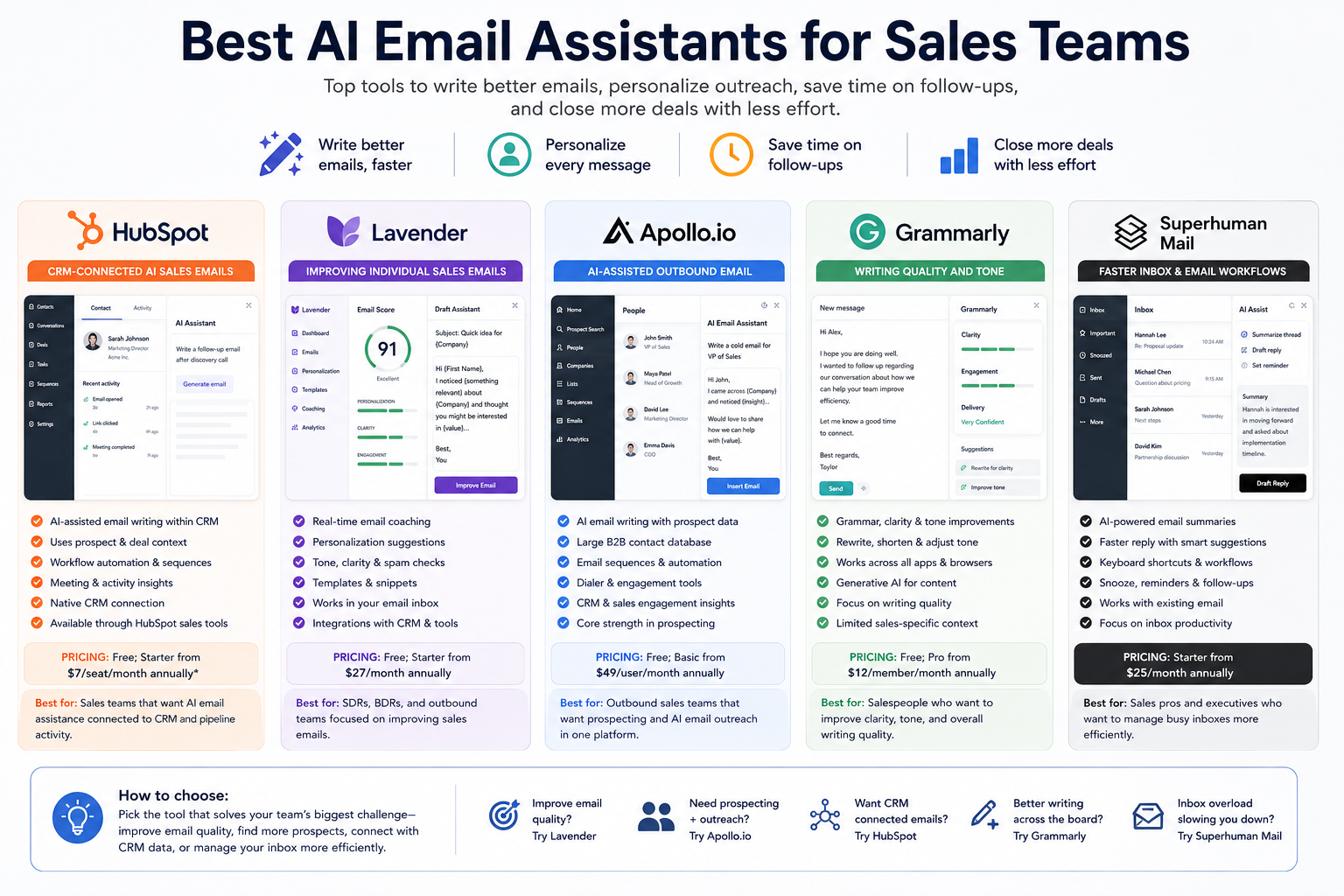
| Platform | Best For | Starting Price | AI Email Writing | Sales Context | CRM Connection | Prospecting |
|---|---|---|---|---|---|---|
| HubSpot | CRM-connected AI sales emails | Free; Starter from $7/seat/month annually* | ✅ | ✅ Strong | ✅ Native | Available through HubSpot sales tools |
| Lavender | Improving individual sales emails | Free; Starter from $27/month annually | ✅ Core strength | ✅ | Integrations | No |
| Apollo.io | AI-assisted outbound email | Free; Basic from $49/user/month annually | ✅ | ✅ | Integrations | ✅ Core strength |
| Grammarly | Writing quality and tone | Free; Pro from $12/member/month annually | ✅ | Limited sales-specific context | Limited | No |
| Superhuman Mail | Faster inbox and email workflows | Starter from $25/month annually | ✅ | Email context | Integrations | No |
Prices shown are starting rates at the time of writing and may vary depending on billing cycle, number of users, features, AI usage, and available promotions. For the most accurate and up-to-date pricing, check each platform’s official website before purchasing.
These tools aren’t direct substitutes for one another.
Lavender is much closer to a specialized sales email coach. Apollo combines email assistance with prospecting and outbound workflows. Grammarly is a general writing assistant, while Superhuman Mail focuses more broadly on inbox productivity.
HubSpot approaches the problem from another direction. Its advantage isn’t simply generating an email. AI-assisted email work can sit within the same sales environment as the prospect’s CRM record, previous activity, deal information, and wider sales process.
1. HubSpot — Best for CRM-Connected AI Sales Emails
HubSpot is best suited to sales teams that want AI email assistance to work alongside CRM data rather than as a separate writing tool.
Imagine a sales representative following up with a prospect after a discovery call.
With a standalone AI writer, the representative may need to provide the context manually: who the prospect is, what was discussed, what they’re interested in, and what should happen next.
With HubSpot, much of that sales context can already exist in the CRM. Previous interactions, contact and company information, deal activity, meetings, notes, and other information can remain associated with the customer record.
That changes the role of AI. Instead of simply asking a tool to “write a follow-up email,” the representative can use AI as part of a broader sales workflow where customer and deal information are already available. HubSpot’s Breeze Assistant documentation explains that the assistant can generate and refine content, summarize information, and help sales teams prepare for meetings, making AI useful for more than simply creating email copy.
For example, a representative preparing for a follow-up can review the prospect’s CRM history, use AI to help draft or refine the message, and continue managing the opportunity without building the context again in a separate writing application.
This becomes particularly useful when a team is trying to increase outreach without increasing administrative work at the same rate. Representatives still control the conversation, but AI can reduce some of the time spent preparing messages and moving between different tools.
That same principle applies when scaling outbound prospecting without adding more SDRs. Removing repetitive research, data entry, and follow-up work can give existing representatives more time for conversations with qualified prospects.
Best for: Sales teams that want AI-assisted email workflows connected to CRM and pipeline activity.
Drawback: Teams that only want an AI writing or email-coaching tool may find a specialized standalone assistant simpler and less expensive than a broader sales platform.
2. Lavender — Best for Improving Sales Email Quality
Lavender takes a more focused approach. Rather than trying to manage the entire sales process, it is designed around helping representatives improve the emails they send.
That makes it particularly relevant for outbound teams whose biggest problem isn’t finding prospects or managing a CRM, but getting representatives to write concise, personalized messages that prospects are more likely to engage with.
Consider an SDR who has researched a promising account but drafted an email that is too long and focused heavily on the seller’s product. A sales-focused email assistant can help identify weaknesses before the message is sent and encourage the representative to make the email clearer and more relevant to the recipient.
This coaching approach can also be useful for managers. Instead of reviewing every email manually, teams can establish more consistent writing habits while still allowing individual representatives to adapt their messages to each prospect.
Lavender therefore serves a different role from HubSpot. HubSpot provides more of the surrounding CRM and sales context; Lavender concentrates more narrowly on the quality of the email itself.
Best for: SDRs, BDRs, account executives, and outbound teams that want focused assistance improving sales emails.
Drawback: Teams that need CRM, prospecting, pipeline management, and broader sales automation will generally need Lavender alongside other sales software rather than using it as their main sales platform.
3. Apollo.io — Best for AI Email Assistance and Outbound Prospecting
Apollo.io makes more sense when email writing is closely connected to finding people to email in the first place.
The platform combines prospecting data with sales engagement capabilities, allowing outbound teams to identify potential buyers, organize prospect lists, and manage outreach from the same broader environment.
For example, an SDR targeting finance directors at mid-sized software companies could use prospecting filters to build an audience and then use AI assistance to help prepare messaging for that segment.
This reduces the separation between prospect research and outreach preparation.
It also means Apollo competes with HubSpot differently from a tool such as Lavender. The question isn’t simply which platform writes the better email. Sales teams need to consider whether they primarily want a prospecting database and outbound platform or a broader CRM-centered sales system.
Teams evaluating that difference may also want to consider how the platforms fit into the wider AI prospecting workflow, including contact discovery, qualification, outreach, and CRM integration.
Best for: Outbound sales teams that want prospect discovery and AI-assisted email outreach within the same platform.
Drawback: Businesses that want marketing, sales, service, and customer information connected through one central CRM may prefer a broader customer platform rather than making prospecting software the center of their sales stack.
4. Grammarly — Best for Improving Clarity, Tone, and Writing Quality
Grammarly isn’t built specifically for sales teams, but it can still be useful for representatives who spend a large part of their day writing emails.
Its strength is improving the quality of the writing itself. Salespeople can use Grammarly to tighten sentences, adjust tone, correct grammar, rewrite awkward passages, and generate or refine text without needing a dedicated sales email platform.
Imagine an account executive replying to a prospect who has raised concerns about pricing and implementation. The challenge isn’t necessarily generating an entirely new email. The representative may already know what needs to be said but want the response to sound clearer, more confident, and less defensive.
That’s where a general writing assistant can be useful.
Grammarly can also fit naturally into teams that communicate across several applications rather than working entirely inside one CRM or sales engagement platform. Representatives may use it for prospect emails, proposals, internal messages, follow-ups, and other business communication.
The limitation is context. Grammarly can help improve what a salesperson writes, but it isn’t primarily designed around CRM records, deal stages, prospecting data, or sales pipelines.
Best for: Salespeople who primarily want AI assistance improving the clarity, tone, and quality of their writing.
Drawback: It lacks the deeper sales and CRM context available in platforms designed specifically around prospecting or sales workflows.
5. Superhuman Mail — Best for AI-Powered Inbox Productivity
Superhuman Mail approaches AI email assistance from another angle: helping busy professionals spend less time managing their inboxes.
For sales representatives handling large numbers of active conversations, writing the initial email is only part of the workload. They also need to read replies, understand long threads, decide which conversations require attention, prepare responses, and keep important opportunities from getting buried.
AI-assisted inbox features can help reduce some of that friction.
Consider an account executive returning from several customer meetings to dozens of new emails. Some may be routine internal messages, while others contain questions from active prospects or developments in ongoing deals. An AI-powered email workflow can help the representative understand conversations more quickly and prepare responses without manually working through every thread from the beginning.
This makes Superhuman Mail more relevant to email productivity than dedicated outbound prospecting.
A salesperson who mainly needs help improving cold emails may get more value from Lavender. A team that needs prospect data and outbound sequences may prefer Apollo. HubSpot becomes more relevant when email activity needs to remain closely connected to CRM and pipeline information.
Best for: Salespeople and executives who manage busy inboxes and want AI assistance handling email more efficiently.
Drawback: It isn’t a complete CRM or prospecting platform, so teams still need other software to manage contacts, opportunities, pipelines, and broader sales processes.
AI Email Assistant vs AI Sales Platform: What’s the Difference?
The distinction can become confusing because many modern sales platforms now include AI email features.
A dedicated AI email assistant typically focuses on the message itself. It might help write an email, improve its tone, shorten it, personalize it, summarize a conversation, or suggest a response.
An AI sales platform goes further by connecting those capabilities with other parts of the selling process.
For example, an outbound platform might combine prospect data with email creation and sequences. A CRM-based platform can connect email activity with contact records, meetings, deal stages, previous interactions, and follow-up tasks.
Neither approach is automatically better.
A salesperson who already has a CRM and simply wants better emails may not need another large sales platform. A growing sales team struggling with disconnected prospect data, email conversations, and pipeline information may get more value from keeping those activities connected.
The practical question is therefore not simply “Which AI writes the best email?” It is “Which parts of our sales email workflow actually need improvement?”
Can AI Email Assistants Make Sales Emails More Personal?
They can help, but personalization depends heavily on the information available to the AI.
Basic personalization might insert a prospect’s name, company, or job title. That doesn’t necessarily make an email relevant.
More meaningful personalization uses context to explain why the salesperson is contacting that particular person. For example, a useful message might refer to a recent conversation, a problem the prospect mentioned, the stage of an ongoing evaluation, or a relevant business need. This is increasingly how AI email tools are developing; Google’s overview of Gemini in Gmail shows how AI can use email context to generate more relevant replies rather than simply producing generic copy.
That’s one reason CRM-connected AI can be useful. When previous conversations and customer information are already associated with a record, representatives have more context available when preparing the next message.
However, salespeople should still review AI-generated personalization carefully. Incorrect assumptions about a prospect can make an automated email feel less personal rather than more.
Should Sales Teams Automate AI-Generated Emails?
AI can make email automation faster, but sales teams should be careful about automatically sending everything AI generates.
Automation works well for repetitive steps such as organizing follow-ups, preparing drafts, summarizing conversations, or supporting structured outreach workflows. Higher-value conversations usually benefit from human review.
This is especially important once a prospect begins responding.
An automated first-touch campaign may follow a repeatable structure, but a prospect asking detailed questions about implementation, pricing, security, or contract terms is having a real sales conversation. At that point, the representative’s judgment becomes much more important.
The most effective approach is usually AI-assisted rather than AI-controlled selling.
Let AI reduce repetitive work. Let salespeople handle context, judgment, relationships, and important decisions.
How to Choose the Best AI Email Assistant for Your Sales Team
Start with the problem your representatives are actually experiencing.
If salespeople spend too much time writing and rewriting individual prospecting emails, Lavender offers a focused approach to improving sales messages.
If the bigger challenge is finding prospects and then contacting them efficiently, Apollo.io combines prospecting and outreach more naturally.
If representatives already know what they want to say but need help improving grammar, clarity, and tone, Grammarly may be enough.
If inbox overload is the problem, Superhuman Mail is more directly focused on making email management faster.
HubSpot makes more sense when the problem extends beyond writing emails. If representatives need email activity, customer history, meetings, follow-ups, deals, and pipeline information to remain connected, a CRM-based approach can reduce the amount of context that needs to be recreated every time someone contacts a prospect.
The right choice therefore depends less on which platform has the most AI features and more on where email fits into the rest of your sales process.
Frequently Asked Questions
What is the best AI email assistant for sales teams?
It depends on the workflow. HubSpot is a strong choice for CRM-connected AI email assistance, Lavender specializes in improving sales emails, and Apollo combines AI-assisted outreach with prospecting. Grammarly and Superhuman Mail are better suited to broader writing and inbox productivity.
Can HubSpot use AI to help write sales emails?
Yes. HubSpot provides AI capabilities that can help sales teams draft and refine content while working within its broader CRM and sales environment. This makes it particularly useful when email is part of a wider workflow involving contacts, deals, meetings, and follow-ups.
Is Lavender better than HubSpot for sales emails?
Lavender is more specialized in coaching and improving individual sales emails. HubSpot is broader and makes more sense when email assistance needs to work alongside CRM records, pipeline activity, automation, and other sales tools.
Can AI write personalized cold emails?
Yes, but the quality of personalization depends on the information available. AI can help tailor messages using prospect or company context, but salespeople should review the result to make sure the personalization is accurate and genuinely relevant.
Are AI-generated sales emails safe to send automatically?
They can be automated in some workflows, but important prospect conversations should generally be reviewed. AI can produce inaccurate or inappropriate content, so representatives should remain responsible for messages sent on their behalf.
How much do AI email assistants cost?
Pricing varies considerably. Some platforms offer free plans, while paid options may charge per user or per month and can become more expensive as teams add advanced sales, AI, CRM, or prospecting capabilities. For the latest and most accurate pricing, check each platform’s official website.
Final Thoughts
The best AI email assistant depends on what is slowing your sales team down.
Lavender is particularly useful when representatives need help improving individual sales emails. Apollo.io makes more sense when email outreach begins with prospect discovery, while Grammarly can improve everyday sales writing and Superhuman Mail focuses more heavily on inbox productivity.
HubSpot takes a broader approach. Its advantage is not simply generating another sales email, but allowing email activity to remain connected with the customer information and sales process surrounding the conversation.
That can be particularly useful for growing teams that don’t want representatives constantly moving between separate AI writing, CRM, and sales tools just to understand who they’re contacting and what should happen next.
For teams that want to see whether a CRM-connected approach fits their sales workflow, HubSpot CRM can be tried for free, providing a practical starting point for bringing customer information, sales activity, and AI-assisted communication into the same environment.
